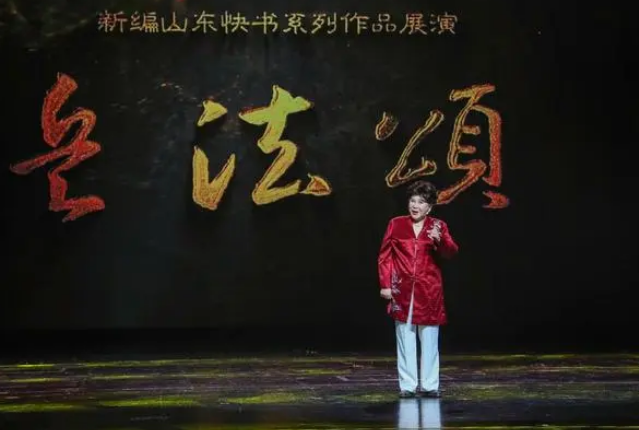
Shandong Kuaishu
Introduction
Shandong Kuaishu is a traditional Chinese storytelling art form performed with rhythmic clappers and spoken in the Shandong dialect. Characterized by its fast-paced delivery and humorous tone, it is a distinctive form of quyi (traditional Chinese folk performance). Officially recognized as a National Intangible Cultural Heritage of China in 2006, Shandong Kuaishu has a rich history and profound cultural significance.
History
Shandong Kuaishu has multiple origin stories:
One attributes its creation to Liu Maoji, a failed military candidate during the Ming Dynasty (1368-1644) (Wanli reign).
Another suggests Fu Hanzhang, a Shandong drum artist in the Qing Dynasty (1644-1911), as its founder.
A third theory credits Zhao Dawei, a scholar from the Xianfeng reign of the Qing Dynasty, as the originator.
The most accepted narrative places its development during the Daoguang era under Fu Hanzhang's influence. Initially rooted in Shandong's rural areas, Shandong Kuaishu gradually gained popularity in urban centers through performances by renowned artists like Gao Yuanjun and Yang Lide in the 20th century. It evolved into a prominent art form across northern and eastern China.
Artistic Characteristics
Performance Style
Shandong Kuaishu primarily features rhythmic recitations (yun-song) with interspersed spoken passages (bai).
Performers use wooden clappers as both percussion instruments and props to enhance rhythm and expression.
The singing incorporates techniques such as "plain delivery" (pingkou), "lively delivery" (qiaokou), and "rapid-fire delivery" (guankou).
Language and Lyrics
The lyrics are written in seven-character rhyming verse, reflecting colloquial expressions and vivid imagery.
Spoken segments include narrative explanations (biaobai) and interjections or commentary (guokoubai).
Themes and Repertoire
Traditional stories from Water Margin dominate early Shandong Kuaishu, particularly tales of Wu Song, such as Wu Song Fights the Tiger, The Crossroads Inn, and The Courtroom Commotion.
Cultural Impact and Legacy
Shandong Kuaishu has significantly influenced other forms of Chinese quyi and regional storytelling arts. Two prominent performance styles emerged in the mid-20th century. Photo Gallery(1 picture)CategoriesArtsTagIntangible Cultural HeritageChinese Folk LiteratureOpera and DramaRelatedShandong DrumCatalogue1. Introduction2. History3. Artistic Characteristics4. Cultural Impact and Legacy- - - []








